
PROVIDER ACTIVATION INFRASTRUCTURE FOR HEALTHCARE
The System
Behind the System
The future of healthcare growth depends on infrastructure most organizations still underestimate.

The System Behind the System
Executive Summary
Healthcare organizations are under pressure to grow.
More access. More efficiency. More automation. More revenue.
Investment is not the problem. There is no shortage of tools, platforms, or initiatives aimed at improving performance across the system.
And yet, the same issues continue to surface.
Provider operations is not administrative overhead. It’s infrastructure.
Providers take too long to onboard.
Claims are denied for preventable reasons.
Revenue is delayed or lost.
Teams expand simply to keep the process moving.
These are not isolated operational issues. They are signs that something more foundational is not working.
Most organizations still treat provider operations as administrative workflows.
That framing is the problem.
Provider data, credentialing, enrollment, directory accuracy, and provider readiness now directly influence revenue performance, compliance exposure, patient access, and organizational scalability.
This is not an operational inconvenience.
It is infrastructure.
This paper explores why Provider Operations Infrastructure has become one of the most important and overlooked layers in modern healthcare organizations, and why strengthening it has become essential for growth, operational resilience, and long-term performance.
1. The Problem Isn’t Where You Think It Is
Healthcare has spent the last decade investing heavily in performance.
Patient engagement platforms. Revenue cycle optimization. Workforce tools. AI.
On paper, it should be working.
But there is still a disconnect between where organizations are investing and where operational breakdowns continue to appear
The instinct is often to focus downstream. Improve access. Optimize billing. Automate workflows.
But many of those initiatives are working against infrastructure upstream that has never been fully addressed.
The issue is not what happens at the point of care or even at the point of billing.
It starts earlier.

2. The System Behind the System
There is a system underneath healthcare operations that most organizations do not clearly define.
It determines whether providers can be onboarded, enrolled, scheduled, billed, and reimbursed.
It spans provider data, credentialing, enrollment, directory management, compliance, and readiness.
It is not owned by one team. It does not live in one platform. It rarely appears on an organizational chart.
But it exists.
And when it becomes fragmented, disconnected, or unreliable, everything above it becomes harder to manage.
Providers are delayed. Revenue becomes inconsistent. Teams operate reactively.
Compliance risk increases.
The challenge is not that this system does not exist.
The challenge is that most organizations do not treat it like infrastructure.
3. Complexity Has Outpaced the Infrastructure
Healthcare has become more complex faster than Provider Operations
Infrastructure has evolved to support it.
Provider networks continue to expand. Regulatory requirements continue to increase.
Organizations operate across multiple entities, systems, and payer environments.
Behind every provider are hundreds of data points that must remain accurate, current,
and consistent across systems.
In many organizations, that information still moves through spreadsheets, inboxes,
manual tracking, and disconnected workflows.
Teams compensate the only way they can. They add people. They create
workarounds. They build processes around the gaps.
But the underlying infrastructure itself does not improve.
That is why the same operational pressure points continue to return.
Onboarding slows down. Data becomes harder to trust. Compliance exposure increases. Revenue leaks in ways that are difficult to trace back to a single source.
This is not simply a workflow problem.
It is what happens when infrastructure is asked to scale beyond what it was designed to support.

4. Credentialing Is Where the Impact Starts
Credentialing is often viewed as administrative work.
In practice, it determines when providers can begin generating value for the organization.
If credentialing is delayed, providers cannot see patients. If enrollment is incomplete, services cannot be billed. If provider data is inaccurate, claims become vulnerable to denial.
Everything downstream depends on this layer functioning correctly.
When it does not, the impact spreads quickly.
Providers remain idle. Claims are delayed or denied. Revenue becomes unpredictable.
Teams spend more time resolving issues than preventing them.
It is easy to describe this as operational friction.
It is more accurate to describe it as infrastructure failure.
5. Why Technology Alone Hasn’t Solved It
There is a common assumption that more technology will solve these challenges.
Automation. AI. Additional platforms layered onto existing workflows.
Technology helps, but it does not solve the underlying issue on its own.
Because the challenge is not simply speed.
It is trust.
If provider data lacks integrity, automation accelerates errors. If workflows are inconsistent, technology creates more variation instead of less.
Provider operations is not administrative overhead. It’s infrastructure.
Without strong governance, connected workflows, and reliable provider data, technology increases complexity rather than reducing it.
6. Where the System Breaks
Most leaders see the symptoms.
Fewer see how they connect.
What appear to be separate issues across onboarding, enrollment, compliance, and revenue are often a single system breaking in multiple places simultaneously.
The easiest way to understand it is to follow the path from provider data to provider readiness and revenue realization.
When provider data is fragmented, errors are introduced early.
When credentialing relies on incomplete information, approvals slow down.
When enrollment lacks visibility, providers are not billable.
When directories are inaccurate, patient access suffers.
When claims are submitted with poor upstream data, denials increase.
When denials increase, revenue becomes unpredictable.
By the time the issue appears in revenue cycle operations, the root cause is already upstream.
Most organizations respond where the problem becomes visible. They add workflows, staff, tracking systems, or remediation processes. Those efforts matter, but they rarely hold long term. Because the issue is not one disconnected workflow.
It is the infrastructure connecting them.
7. A Different Way to Think About the Problem
The organizations making progress are not simply asking how to improve individual workflows.
They are asking a different question.
Do we have the right infrastructure in
place to support provider operations
at scale? That shift matters.
Because provider operations are not a single administrative function. They are a connected operational system spanning provider data, credentialing, enrollment, compliance, readiness, and reimbursement.
When that infrastructure operates cohesively, everything downstream becomes more predictable.
Organizations gain visibility. Teams spend less time reacting. Providers onboard faster. Revenue performance stabilizes.
The goal is not simply operational efficiency.
It is operational reliability.
8. What It Costs to Ignore It
When organizations fail to address this layer, they compensate elsewhere.
They hire additional staff. Add more technology. Build more processes. Create more oversight.
It keeps the system moving, but it does not solve the underlying issue.
Over time, the cost appears in slower onboarding timelines, persistent denials, rising operational burden, provider frustration, and limited ability to scale.
Growth becomes dependent on how much complexity the organization can absorb rather than how efficiently it can operate.
9. What Changes When It Works
When Provider Operations Infrastructure is connected and reliable, the experience changes across the organization.
Providers move through onboarding faster. Enrollment becomes more predictable. Data becomes more trustworthy. Claims become cleaner. Revenue flows sooner.
Teams spend less time chasing operational issues and more time managing performance strategically.
The organization begins operating from a foundation it can trust rather than constantly working around fragmentation.
This is not about incremental workflow improvement.
It is about building infrastructure capable of supporting sustainable growth.

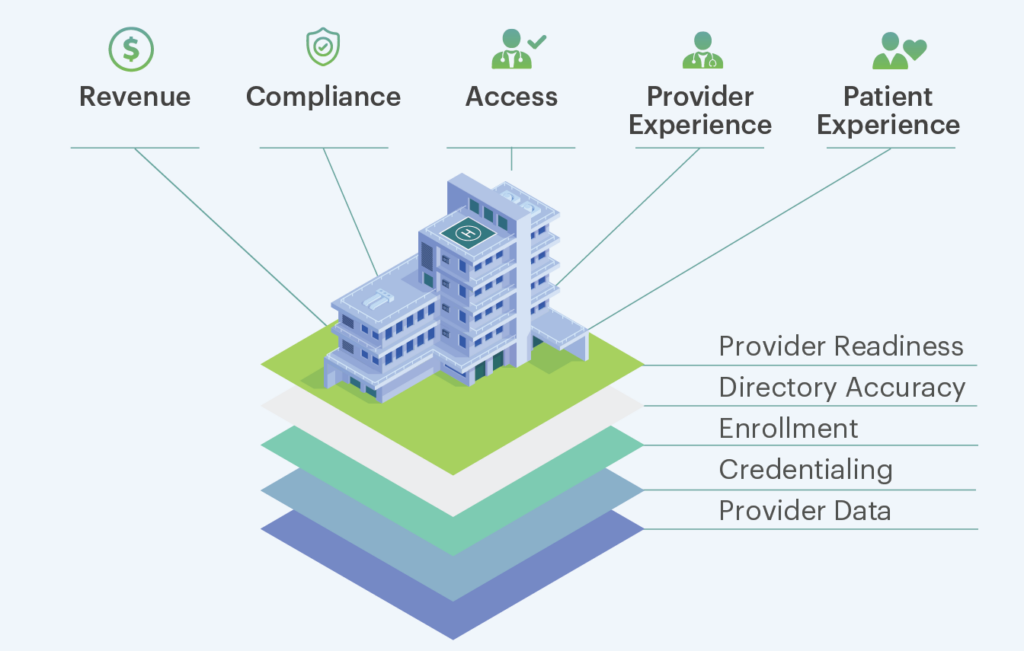
10. The Layers of Provider Operations Infrastructure
Provider operations are often experienced as disconnected tasks spread across teams
and systems.
In reality, they function as a connected infrastructure layer where each component
depends on the integrity of the layer beneath it.
At the foundation sits
provider data.
Enrollment connects providers to payer networks and reimbursement eligibility.
Directory accuracy ensures provider information remains consistent and reliable across systems, networks, and patient-facing experiences.
At the top sits provider readiness, the point where providers can fully deliver care, support patient access, and generate revenue for the organization.
When these layers operate independently, organizations experience delays, denials,
operational friction, and limited visibility.
When they operate as connected infrastructure, provider operations become more scalable, resilient, and predictable.
11. The Role of Acorn
Acorn was built to strengthen the Provider Operations Infrastructure healthcare organizations depend on but often struggle to manage cohesively.
Rather than treating provider data, credentialing, enrollment, directory management, and provider readiness as disconnected workflows, Acorn connects them within a unified provider operations platform designed for visibility, consistency, and scale.
By centralizing Provider Operations Infrastructure, organizations can reduce fragmentation, improve provider data integrity, accelerate onboarding timelines, strengthen compliance oversight, and create more predictable revenue performance.
This approach allows healthcare teams to move beyond reactive workarounds and operate from a more connected operational foundation.
The goal is not to help teams work harder inside complexity.
The goal is to reduce that complexity so the system itself works more effectively.
Because the challenge is not simply completing administrative tasks faster.
It is creating infrastructure healthcare organizations can trust to support growth, compliance, access, and long-term operational performance.
Conclusion
Healthcare organizations do not simply have a credentialing problem.
They have an infrastructure problem.
Until that infrastructure is addressed, improvements in other operational areas will
continue running into the same limitations.
The organizations that move first will be the ones that recognize what this layer actually is and invest in it accordingly.
Because once the system underneath healthcare becomes visible, the path
forward becomes much clearer.
Stop managing the symptoms.
Strengthen the infrastructure
causing them.
Call to Action
The future of healthcare growth depends on provider operations infrastructure.
The organizations improving provider readiness, accelerating revenue, and reducing administrative burden are not simply adding more technology. They are strengthening the infrastructure behind provider operations.
Schedule a demo to see how Acorn helps healthcare organizations
connect provider data, credentialing, enrollment, directory management, and provider readiness through a unified operational platform.