In today’s healthcare environment, quality in provider operations is no longer optional. It is foundational.
Credentialing, provider enrollment, privileging, FPPE and OPPE oversight, and provider data management all directly impact operational performance, accreditation readiness, provider activation timelines, reimbursement continuity, and organizational trust.
Yet many healthcare organizations still manage these functions through fragmented systems, manual workflows, disconnected spreadsheets, and inconsistent operational processes.
The result is growing administrative burden, limited visibility, increased compliance risk, and operational inefficiency across the provider lifecycle.
High-performing healthcare organizations are taking a different approach.
They are building connected provider operations infrastructure designed to improve visibility, standardize oversight, strengthen data integrity, and support scalable growth.
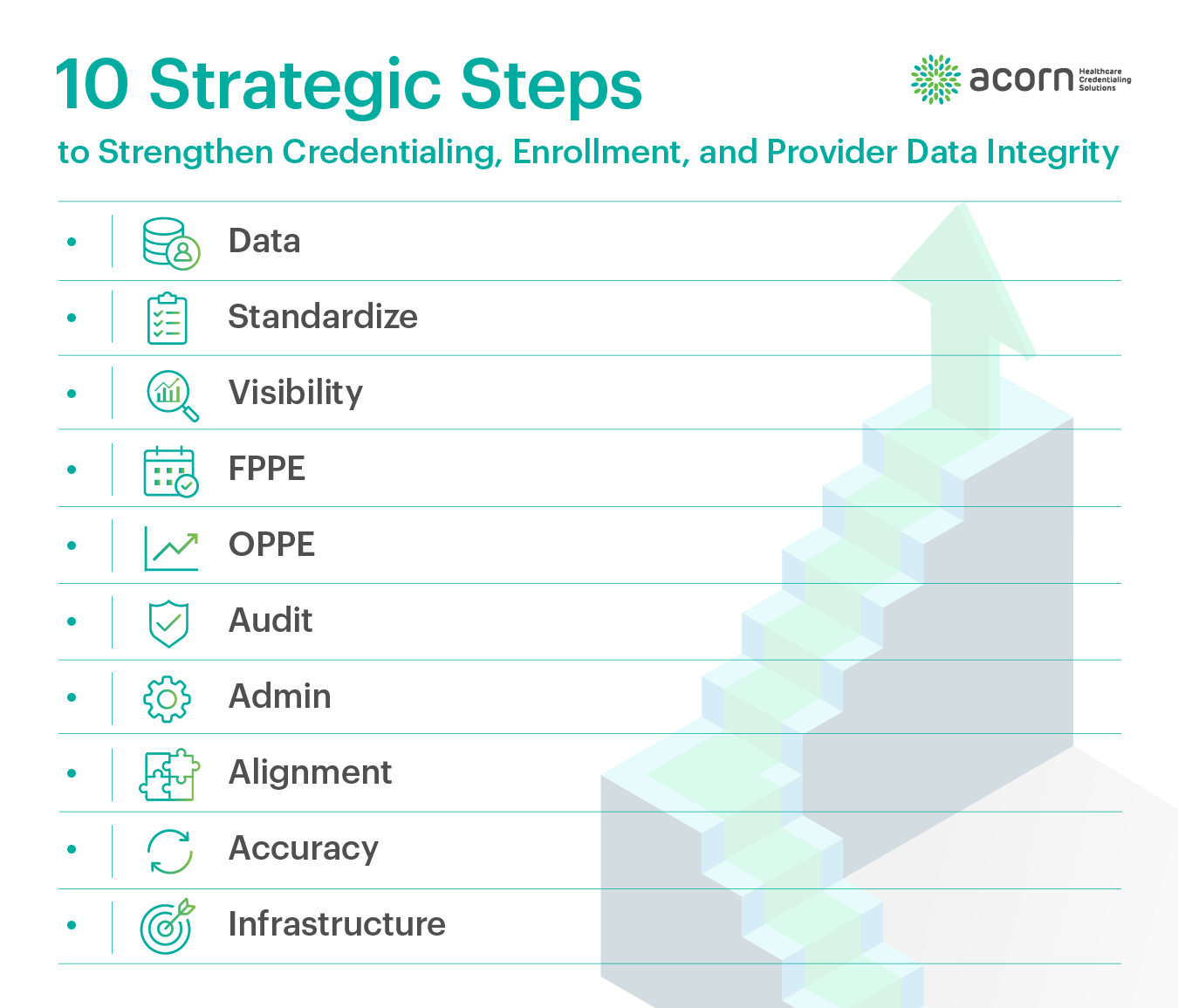
Here are 10 strategic steps healthcare organizations can take to strengthen credentialing, enrollment, and provider data operations.
1. Centralize Provider Data Management
Disconnected provider records create operational risk, enrollment delays, and inconsistent oversight across departments and systems.
Establishing a centralized source of truth for provider data improves visibility, strengthens data integrity, and reduces duplication across credentialing, enrollment, privileging, and quality workflows.
2. Standardize Credentialing Processes Across the Organization
Variability in credentialing workflows increases administrative complexity and creates unnecessary compliance risk.
Standardized operational processes and documentation requirements help organizations improve consistency, reduce delays, and support more defensible oversight practices across departments and facilities.
3. Improve Visibility Into Provider Enrollment Status
Provider enrollment delays directly affect revenue cycle performance and patient access.
Healthcare organizations should implement systems that allow operational leaders to quickly identify payer enrollment bottlenecks, missing documentation, and participation status in real time.
4. Automate FPPE Tracking and Documentation
Focused Professional Practice Evaluation processes should be structured, trackable, and audit-ready at all times.
Automated milestone tracking, centralized documentation, and built-in workflow visibility help organizations improve consistency while reducing administrative burden for medical staff offices.
5. Create Continuous OPPE Visibility
Ongoing Professional Practice Evaluation should support proactive provider oversight rather than retrospective reporting.
Centralized scorecards, quality indicators, and performance trend visibility help medical staff leaders make informed privileging and review decisions with greater confidence.
6. Strengthen Audit and Accreditation Readiness
Preparing for audits and accreditation reviews should not require last-minute operational scrambling.
Organizations that maintain centralized, defensible, audit-ready documentation throughout the provider lifecycle are better positioned to reduce compliance risk and respond efficiently to regulatory requests.
7. Reduce Manual Administrative Workflows
Medical staff offices and provider operations teams are under increasing pressure to do more with fewer resources.
Reducing repetitive manual tasks through connected workflows and automation helps teams focus on strategic oversight, provider support, and operational quality improvement.
8. Align Credentialing, Enrollment, and Quality Oversight
Credentialing, enrollment, provider data management, FPPE, and OPPE processes should function as connected operational systems rather than isolated administrative tasks
Organizations that align these workflows create stronger operational continuity, improved accountability, and greater visibility across the provider lifecycle.
9. Improve Provider Data Accuracy Across Systems
Inconsistent provider data across internal systems, payer portals, and external platforms creates downstream operational and reimbursement challenges.
Organizations should establish governance processes that support ongoing provider data validation, accuracy, and consistency organization-wide.
10. Treat Provider Operations as Strategic Infrastructure
Credentialing and provider data management are no longer back-office administrative functions.
They directly impact organizational scalability, compliance readiness, reimbursement continuity, provider activation speed, and operational resilience.
Healthcare organizations that prioritize operational quality in provider operations will be better positioned to scale efficiently, strengthen oversight, and support long-term organizational performance.
At Acorn Credentialing Solutions, we believe provider operations quality should create clarity, confidence, and operational strength across every stage of the provider lifecycle.